
WRT 2025 in Review
2025 was an important year for the Water Resilience Tracker (WRT) and our mission to help governments strengthen water resilience in national climate plans:
1. National policy and climate action impact
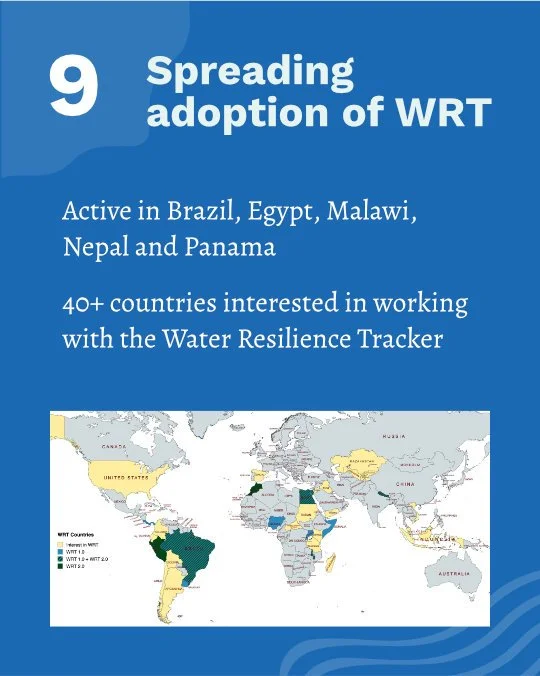
In the four countries where the Water Resilience Tracker was active in 2025 - Brazil, Egypt, Malawi, and Nepal - we held inception workshops and consultations that brought together a broad range of national stakeholders and decision-makers to discuss the findings of the WRT questionnaire that forms the basis for our engagement with countries. The Water Resilience Tracker worked throughout the year in a consultative process to ensure that our activities support national priorities while addressing the recommendations from our assessment of national policies.
The WRT team was closely involved with national water and environment authorities as they updated climate change-related plans and policies in 2025. For example, we helped develop stronger indicators for the water sector in Malawi's updated National Adaptation Plan and Nepal's third Nationally Determined Contribution (NDC3.0) as well as its implementation plan (NDC3.0 IP). In Brazil, the National Climate Policy (Plano Clima) includes an adaptation pillar with 16 sectoral NAPs, of which one is now fully focused on water resources. In this way, the Water Resilience Tracker had a direct policy impact in addition to the broader impact of engaging with the Tracker tool, its findings and recommendations. Across all consultations, we engaged 256 people (31% women).
2. Supporting countries to close the climate finance gap
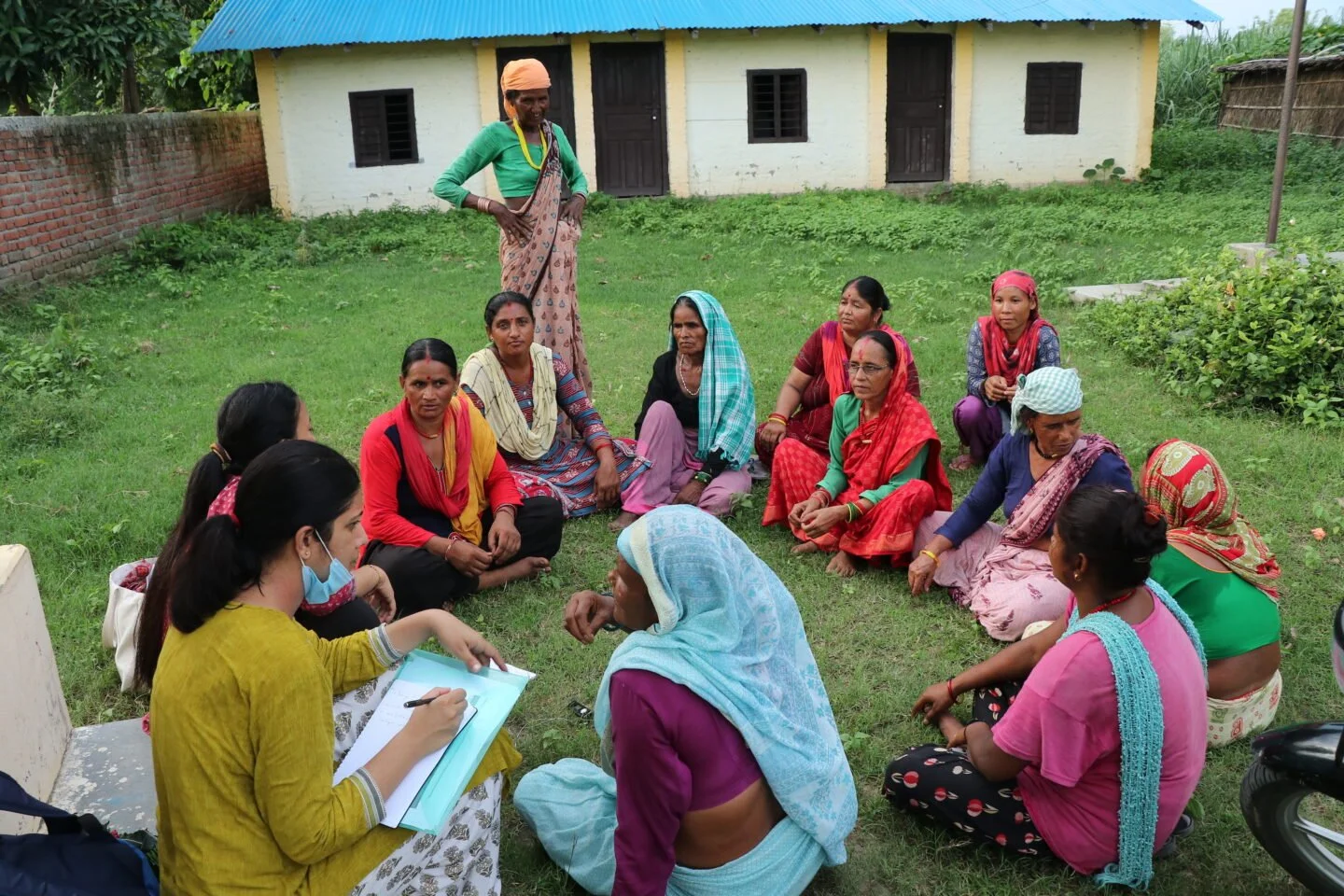
Capacity building was a key need identified in stakeholder consultations, for example closing the climate finance gap and navigating global processes such as the UNFCCC Conference of Parties (COP) conferences. In Nepal, we provided focused trainings to 55 stakeholders (47% women) in climate negotiations and in accessing climate finance, supported the government to draft a COP30 position paper and hold a post-COP30 knowledge sharing event. In 2026, we will build on this progress by further developing and offering capacity building to more countries, with Malawi having already agreed on a training programme that will help them seek finance for key water infrastructure projects.
3. Celebrating our close collaboration with Brazil
The enthusiastic promotion of water resilience and WRT's approach by our partners in Brazil was a clear highlight of 2025. "The Water Resilience Tracker has been an important tool in helping us identify critical gaps and strengthen adaptation strategies that place water resilience at the centre of climate action in Brazil”, according to Ana Paula Fioreze, National Water Agency of Brazil, at the launch of our Brazil country report.
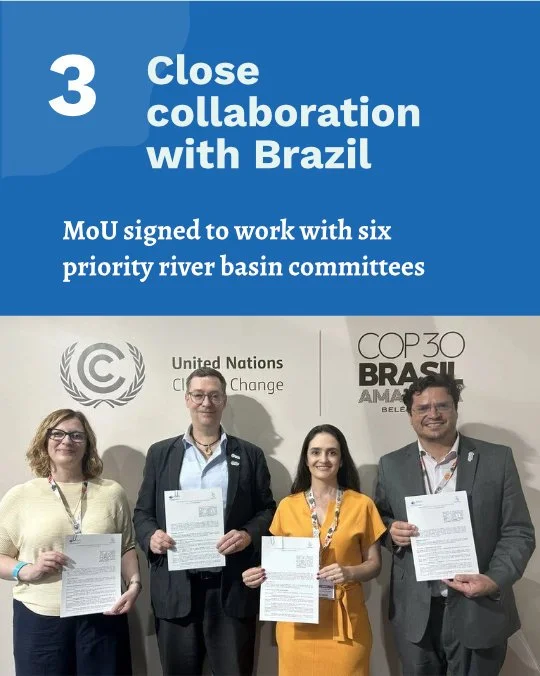
Our partners in Brazil championed water resilience at COP30, calling for a dedicated "Water Day" and a "Water Hub", and providing numerous spaces to showcase the work of the Tracker in Brazil. To round off the year, we signed an MoU for the second phase of collaboration in Brazil, that will see us working directly with authorities and partners in six river basins throughout 2026.


4. Growing the knowledge base on water resilience
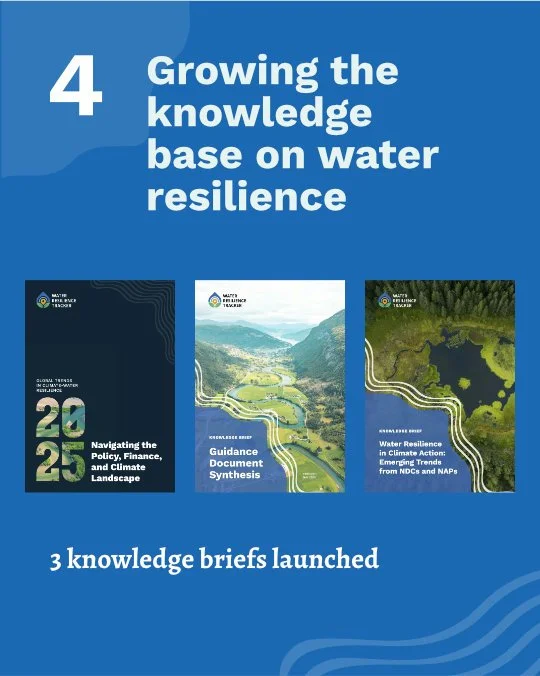
At the global policy level, we released several important reports and briefs to raise awareness of the water resilience agenda. This included a synthesis of the Tracker Guidance Document, which provides our partners with examples of best practices for water resilience in national policies. Our Global Trends Report launched at World Water Week in Stockholm is an essential guide to navigating the policy, finance and climate landscape. Launched at COP30, Water Resilience in Climate Action looked at emerging trends in NAPS and NDCs, demonstrating how national planning is becoming more sophisticated in its adoption of water resilience principles and providing examples of best practices. We launched a dedicated website - www.waterresiliencetracker.cc - to serve as a knowledge base and a platform to keep up with WRT activities.

5. Driving the water resilience agenda
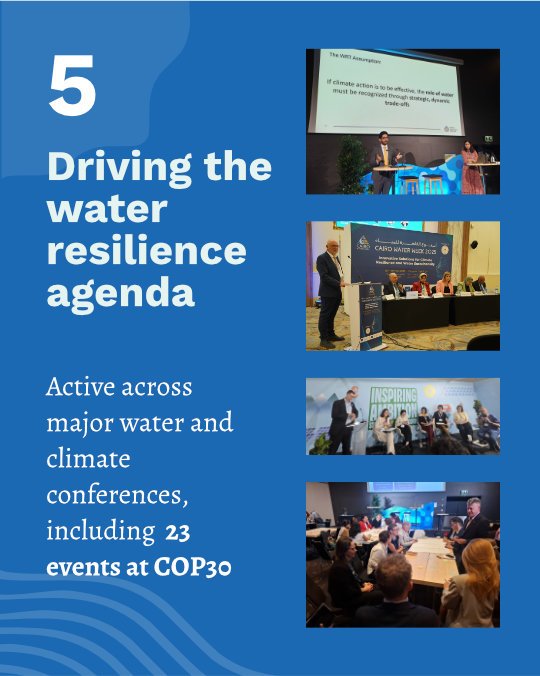
The Water Resilience Tracker team was highly active across major water and climate events in 2025, hosting sessions at Stockholm World Water Week and Cairo Water Week, participating in 23 events at COP30, along with several other international and country-level events. To learn more about our perspective on water resilience in multilateral climate processes, watch our webinar covering this and everything that took place at COP30 in Brazil.
6. Advancing the Water Resilience Tracker methodology
The tools used by the Water Resilience Tracker are constantly evolving. In 2025, the Tracker questionnaire was revised to incorporate experiences and feedback from country implementation, contributing to a growing evidence base and practical tools for countries to assess, plan, and improve water resilience strategies. This revision included incorporating gender, equality and social inclusion (GEDSI) strategies. In Brazil, artificial intelligence was used to accelerate the application of our tools to national policies, and we will continue to improve our approach throughout our experiences working at the sub-national level. Based on engagements in Malawi and Egypt, as well as the preliminary introduction of the Global Goal on Adaptation indicators, WRT has been developing a framework for resilience indicators; this work will lead up to methodological guidelines for National Resilience Indicator Frameworks.
7. Just Transitions for Water Security
In some countries, the Water Resilience Tracker works alongside our sister initiatives in the Just Transitions for Water Security (JTWS) programme, funded by the UK Foreign and Commonwealth Development Office (FCDO). Fair Water Footprints works across global value chains to reduce water impacts and improve resilience; the Resilient Water Accelerator helps catalyse flows of public and private finance; and the Water Resilience Tracker provides policymakers with tools and guidance to design and implement water-smart policies.
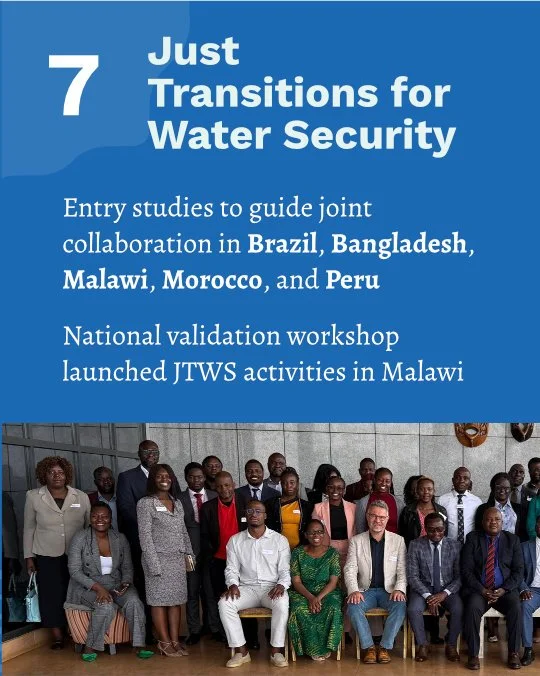
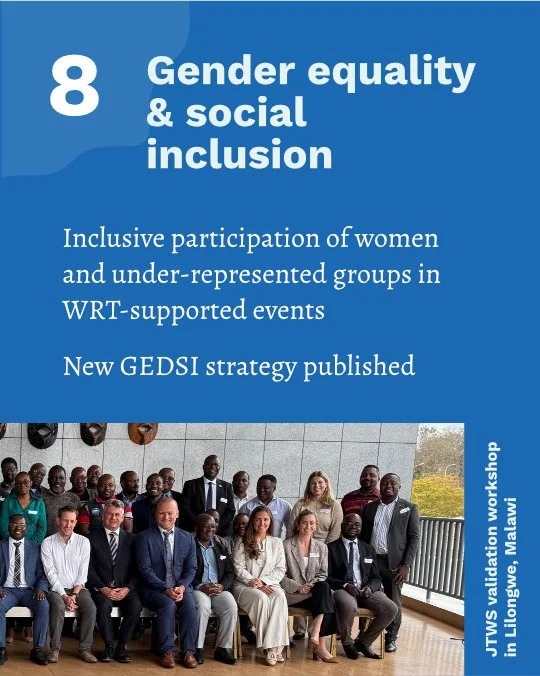
In 2025, the Water Resilience Tracker released five joint country entry studies, which set the stage for the JTWS initiatives to collaborate in countries such as Brazil, Bangladesh, Malawi, Morocco, and Peru. In August, we brought together stakeholders in Malawi to validate the JTWS programme and launch our collaboration in the country.
8. Embedding gender equality and social inclusion
Climate change does not affect everyone equally. Climate impacts are amplified by existing inequalities—particularly those related to gender, age, ability, caste, ethnicity, and economic status. The Water Resilience Tracker addresses this in two ways: encouraging and tracking participation of under-represented groups in our events and training, and GEDSI lens across our tools and engagement so that WRT itself can be a force for inclusion. We have been intentional in applying GEDSI approaches in our workplan and activities, for example insisting on the inclusive participation of women and under-represented groups.
In 2025, we published our GEDSI strategy, while in 2026 we will continue to strengthen the inclusion of GEDSI in our work, including with the new hire of a GEDSI specialist.
9. Generating interest to spread adoption of the Water Resilience Tracker
Throughout the course of the Water Resilience Tracker initiative, we have registered interest from over 40 countries in working with us to embed water resilience principles in national planning. At Cairo Water Week, WRT was identified as a useful tool for regional cooperation as a potential common framework to encourage dialogue.
In 2026, we are building on last year's progress, starting with the launch of a new country programme in Morocco, and extending in-country collaboration to work at the sub-national level in Brazil, Egypt, Malawi and Nepal.
If you are interested in working with the Water Resilience Tracker or supporting us to expand our scope of work, reach out to our Director Idrees Malyar, follow us on LinkedIn, or sign up for our newsletter.